Contact centers are under pressure to do more with less: higher customer expectations, more complex queries, and rising operational costs. Agent assist contact center technology, such as iLounge - AI Call Center Solutions, is rapidly becoming the secret advantage that lets teams meet these demands without burning out agents or blowing up budgets. By leveraging AI in call centers data analytics alongside real-time guidance, agent assist tools help every agent perform like your best agent on their best day.
Today’s contact centers rely on cloud computing solutions for customer support, giving businesses the ability to store, manage, and analyze large amounts of data quickly. Combined with modern computer technology systems for call centers, agents can access critical information instantly and work more efficiently. These tools also enhance digital marketing strategies using AI, allowing companies to deliver personalized messages, improve customer engagement, and measure campaign results accurately.
In finance, AI applications for banking and financial services help reduce errors, detect fraud, and speed up transactions, providing safer and faster experiences for customers. At the same time, big data analytics for marketing and sales improvement helps businesses understand customer behavior, optimize offers, and improve overall service quality. By combining cloud computing, AI, big data, computer technology, finance, and digital marketing, contact centers create a system where agents can provide faster, smarter, and more satisfying customer interactions.
This approach makes agent assist solutions part of a connected AI-driven customer service platform, supporting operations, marketing, and financial processes while ensuring every customer interaction is seamless and effective.
Top 10 Contact Center Solutions for AI-Driven Agent Assist
When choosing the best platforms for agent assist contact center technology, businesses want solutions that combine AI intelligence, real-time analytics, and omnichannel support. Here are the top 10 contact center solutions helping companies deliver smarter, faster, and more satisfying customer experiences.
1. Bright Pattern – AI-Powered Contact Center Platform
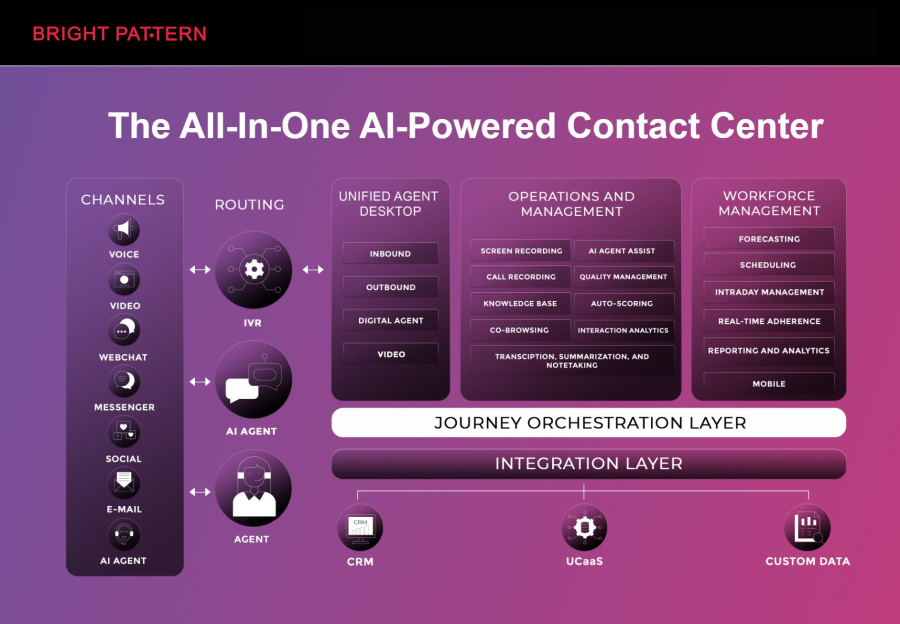
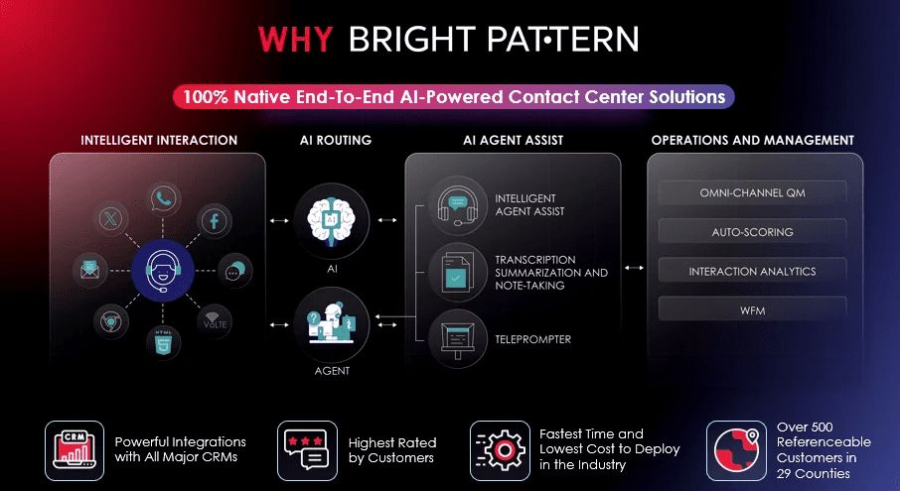
Bright Pattern is a leading AI-driven contact center solution, widely recognized for transforming how agents interact with customers. With robust AI capabilities and real-time guidance, Bright Pattern enables every agent to perform like your best agent on their best day.
Key features include:
- Omnichannel communication: support for voice, chat, SMS, social media, and email in one platform
- Intelligent routing and AI-driven agent assistance to improve first-contact resolution
- AI-powered analytics to track performance and optimize customer journeys
- Cloud-based infrastructure for scalability, security, and remote agent support
- Integrations with CRM, marketing automation, and workforce management tools
Bright Pattern is ideal for businesses looking to streamline operations while enhancing agent productivity and customer satisfaction.
2. Five9 – Cloud Contact Center Software
Five9 offers a cloud-based contact center platform that uses AI to enhance agent performance. Its tools include predictive dialing, real-time analytics, and automated workflows that improve efficiency across voice, email, and chat channels.
3. Genesys – Customer Experience and Contact Center Solutions
Genesys provides AI-enabled solutions to manage multichannel customer interactions. Features like predictive engagement, workforce optimization, and real-time reporting help organizations deliver consistent, high-quality service.
4. NICE inContact – Cloud Contact Center Platform
NICE inContact combines cloud infrastructure with AI analytics to provide advanced routing, performance management, and customer insights, ensuring efficient and personalized service.
5. Talkdesk – AI-Enhanced Call Center Software
Talkdesk offers an AI-powered platform that integrates with CRM systems to automate workflows, improve agent efficiency, and deliver actionable insights from customer interactions.
6. Avaya – Unified Contact Center Solutions
Avaya provides enterprise contact center solutions with AI-based analytics, omnichannel support, and intelligent routing, enabling agents to deliver faster and more accurate responses.
7. RingCentral – Cloud Contact Center Software
RingCentral offers a scalable cloud contact center with AI capabilities for call routing, workforce optimization, and performance analytics, designed for both small businesses and large enterprises.
8. 8x8 – AI-Powered Customer Engagement Platform
8x8 provides AI-driven call center tools including speech analytics, sentiment analysis, and predictive routing, helping organizations improve agent performance and customer satisfaction.
9. Cisco Contact Center – Intelligent AI Solutions
Cisco’s AI-enabled contact center solutions support multichannel communication, real-time analytics, and intelligent automation to enhance the efficiency and effectiveness of agents.
10. Zendesk – Customer Service and AI Support
Zendesk integrates AI-driven tools into its customer support platform, providing automated ticketing, sentiment analysis, and workflow optimization to improve agent performance and customer experiences.
What Is Agent Assist in a Contact Center?
Agent assistis an AI-powered solution that listens to or reads live customer interactions and provides real-time guidance to the contact center agent. Instead of replacing agents, itaugmentsthem with instant suggestions, next-best actions, and context so they can resolve issues faster and more confidently.
Agent assist can support voice calls, chat, email, and messaging channels. It typically runs in the background and appears as a panel or widget in the agent desktop, surfacing:
- Suggested answers and knowledge articles
- Next-best actions and process steps
- Automated summaries and after-call notes
- Compliance prompts and required disclosures
- Real-time sentiment and escalation signals
The goal is simple:give agents the right information, at the right time, with minimal effort.
How Agent Assist Works in Practice
While implementations vary, most agent assist contact center solutions follow a similar pattern.
1. Capture the Customer Interaction
The system captures the interaction in real time through one of the following:
- Voice callsvia speech recognition to transcribe the conversation as it happens
- Digital channelssuch as chat, email, SMS, or messaging apps, where text is already available
This live stream of text becomes the foundation for understanding what the customer needs.
2. Understand Intent, Context, and Sentiment
Using natural language processing, the AI analyzes the conversation to identify key elements, including:
- Customer intent(for example, cancel a subscription, dispute a charge, update an address)
- Contextfrom previous interactions or account data
- Sentimentand emotional tone to detect frustration, confusion, or satisfaction
- Compliance triggerssuch as disclosures that must be read or consent that must be captured
3. Surface Real-Time Guidance to the Agent
As the AI understands what is happening, it surfaces helpful content directly in the agent's desktop. This may include:
- Suggested responsesthe agent can quickly personalize and send
- Relevant knowledge articlespulled from your internal knowledge base
- Step-by-step workflowsfor complex processes such as identity verification or refunds
- Compliance promptsthat remind agents to read required scripts or capture consent
- Upsell or cross-sell recommendationsbased on customer profile and conversation context
4. Automate Post-Interaction Work
After the interaction, agent assist tools can dramatically reduce wrap-up time by:
- Generatingcall summariesand disposition codes
- Suggesting or auto-fillingCRM notesand case details
- Triggeringfollow-up tasksor workflows
This frees agents to move on to the next customer more quickly, while supervisors benefit from standardized, structured data.
Key Benefits of Agent Assist for Contact Centers
Agent assist delivers measurable wins across customer experience, agent performance, and operational efficiency. Below are the most impactful benefits teams typically see.
1. Faster Handle Times Without Sacrificing Quality
When agents have instant access to the right information, they spend less time searching through multiple systems or asking colleagues for help. This can reduce:
- Average handle time (AHT)as agents resolve issues faster
- Hold timewhile agents look up answers
- Transfersto more experienced agents or back-office teams
Crucially, these efficiency gains do not come at the expense of customer satisfaction; in most cases, they improve it.
2. Higher First-Contact Resolution (FCR)
By surfacing knowledge and next-best actions at the moment of need, agent assist helps agents solve more issues during the first interaction. That means:
- Fewer repeat calls or emails from frustrated customers
- Less operational load on the contact center
- Highercustomer satisfaction (CSAT)andNet Promoter Score (NPS)
3. Consistent, Compliant Customer Interactions
Agent assist helps standardize how agents handle sensitive or regulated interactions by:
- Prompting agents withdisclosuresand required language at exactly the right time
- Guiding agents throughstandard operating proceduresstep by step
- Flaggingpolicy risksin real time so agents can course-correct
This consistency protects your brand, reduces compliance risk, and supports quality assurance efforts.
4. Faster Onboarding and Upskilling
New hires are often overwhelmed by complex products, systems, and processes. Agent assist acts as an always-available coach, which means:
- Shorter ramp-up timesto reach full productivity
- Less reliance on supervisors for routine questions
- Greater confidence for new agents handling difficult scenarios
Tenured agents also benefit as products, policies, and offers change. Instead of memorizing every update, they rely on the AI to keep them informed in the moment.
5. Happier, More Engaged Agents
Agents often leave because they feel stressed, unsupported, or overwhelmed. Agent assist improves the day-to-day experience by:
- Reducing cognitive load and repetitive lookups
- Helping agents handle challenging calls more successfully
- Offering a sense ofback-up and coachingduring live interactions
The result is lower attrition, better morale, and a stronger customer-centric culture.
6. Richer Analytics and Continuous Improvement
Because agent assist tools analyze interactions in real time, they generate high-quality data that can be used to improve operations. Leaders gain insight into:
- Top contact drivers and emerging customer issues
- Which knowledge articles or scripts are most effective
- Where agents commonly get stuck or request help
These insights feed a virtuous cycle of process refinement, content updates, and coaching improvements.
Agent Assist vs. Traditional Contact Centers
To highlight the impact of agent assist, it helps to compare a traditional contact center with one powered by real-time AI support.
| Aspect | Traditional Contact Center | With Agent Assist |
| Access to Information | Agents manually search multiple systems and knowledge bases. | Relevant content and answers are suggested in real time. |
| Consistency | Responses vary widely by agent experience and memory. | AI guidance standardizes responses and processes. |
| Training and Ramp-Up | Long classroom sessions, heavy memorization, high supervision. | On-the-job learning with real-time coaching and prompts. |
| Compliance | Relies on agents remembering scripts and rules. | Automated prompts ensure disclosures and policies are followed. |
| After-Call Work | Manual note-taking, summaries, and dispositions. | AI generates summaries and suggests dispositions automatically. |
| Customer Experience | Inconsistent, slower, more transfers and repeat contacts. | Faster, more accurate, more personalized resolutions. |
High-Impact Use Cases for Agent Assist in Contact Centers
Agent assist is flexible enough to support many different types of contact centers. Some of the most powerful use cases include:
Customer Service and Technical Support
- Diagnosing technical issues step by step with guided troubleshooting flows
- Surfacing device or product-specific knowledge articles in real time
- Offering suggested responses to common questions to speed up resolution
Sales and Retention Desks
- Recommending tailored offers or bundles based on customer profile
- Providing objection-handling prompts during challenging conversations
- Guiding agents through pricing, discount, and approval workflows
Financial Services and Insurance
- Ensuring compliance with regulatory disclosures and scripts
- Validating required steps for identity verification and fraud checks
- Guiding customers through claims, disputes, or application processes
Healthcare and Public Services
- Helping agents follow strict protocols for sensitive information
- Supporting multi-step eligibility and enrollment processes
- Providing clear, consistent explanations of benefits or services
Metrics That Prove Agent Assist Is Working
To track the impact of agent assist in your contact center, it helps to define success metrics upfront. Common key performance indicators (KPIs) include:
- Customer metrics: CSAT, NPS, Customer Effort Score, repeat contact rate
- Efficiency metrics: AHT, first-contact resolution, occupancy, queue times
- Quality and compliance: quality assurance scores, adherence to scripts, error rates
- People metrics: agent satisfaction, attrition, time to proficiency
Organizations that implement agent assist effectively often see double-digit improvements in key metrics such as AHT, FCR, and CSAT, along with faster onboarding and lower training costs.
Designing an Effective Agent Assist Program
Agent assist is not just a technology deployment; it is a strategic shift in how your contact center supports agents. To get the most value, consider these pillars.
1. Start With Clear Objectives
Define the outcomes you want to achieve, such as:
- Reducing handle time by a specific percentage
- Improving first-contact resolution in targeted queues
- Boosting sales conversion or retention in specific campaigns
Clear goals help you prioritize which workflows to automate first and how to configure guidance.
2. Prioritize High-Value, High-Volume Interactions
Agent assist delivers the biggest payoff when applied to interactions that are both frequent and important. Examples include:
- Top call drivers that represent a large share of volume
- Complex processes with multiple steps and compliance risk
- Moments of truth in the customer journey, such as cancellations or complaints
3. Involve Agents Early and Often
Agents are the primary users of agent assist, so their input is crucial. Successful teams:
- Invite agents to help design prompts, workflows, and response templates
- Run pilots with small groups of agents to gather feedback and iterate
- Celebrate quick wins and share success stories to build momentum
4. Keep Knowledge and Workflows Up to Date
Agent assist is only as good as the knowledge and rules it relies on. Build processes to:
- Continuously refine knowledge articles based on usage and feedback
- Update workflows when policies, products, or offers change
- Retire outdated content so agents always see the best guidance
5. Monitor Performance and Optimize
Use analytics from your agent assist solution and contact center platform to:
- Identify which prompts and workflows deliver the best outcomes
- Spot new training opportunities based on where agents still struggle
- Fine-tune automation rules to balance guidance and agent autonomy
Agent Assist and the Future of Hybrid Contact Centers
As customer expectations continue to rise, contact centers are evolving into hybrid environments where automation and human service work side by side. In this new landscape, agent assist plays a central role by:
- Bridging the gap between self-service bots and human agents
- Ensuring live agents step in with full context when escalations occur
- Turning every interaction into a learning moment that improves the system
Rather than replacing people, agent assist tools amplify human strengths: empathy, judgment, and creativity. The technology handles repetitive lookups and process guidance, so agents can focus on what matters most: building trust and delivering memorable experiences.
Conclusion: Turning Every Agent Into a Top Performer
Agent assist in the contact center is more than an incremental upgrade. It is a strategic accelerator that helps you deliver faster, more accurate, and more human customer service at scale.
By giving agents real-time guidance, simplifying complex processes, and capturing rich interaction data, you unlock a powerful combination of higher customer satisfaction, better agent engagement, and stronger operational performance.
For organizations ready to modernize their contact centers, agent assist is one of the most impactful, agent-friendly, and customer-centric technologies available today. When every agent has a smart assistant by their side, every conversation becomes an opportunity to delight customers and strengthen loyalty.
